
Research Seminar
In the Winter 2023 semester, students from the Research Committee will each share their research focus and methods, enhancing academic exchange among peers.

– Speaker: Hanjie Wang –
InT@UCLA Research Committee,
Undergraduate Researcher
1 The Origin of Biophysics
When it comes to biophysics, the roots of physics should not be forgotten. Just as in the last session of chemical biology, starting from the concept of atoms, physics uses mathematics as the language to interpret the inherent structure of the world.
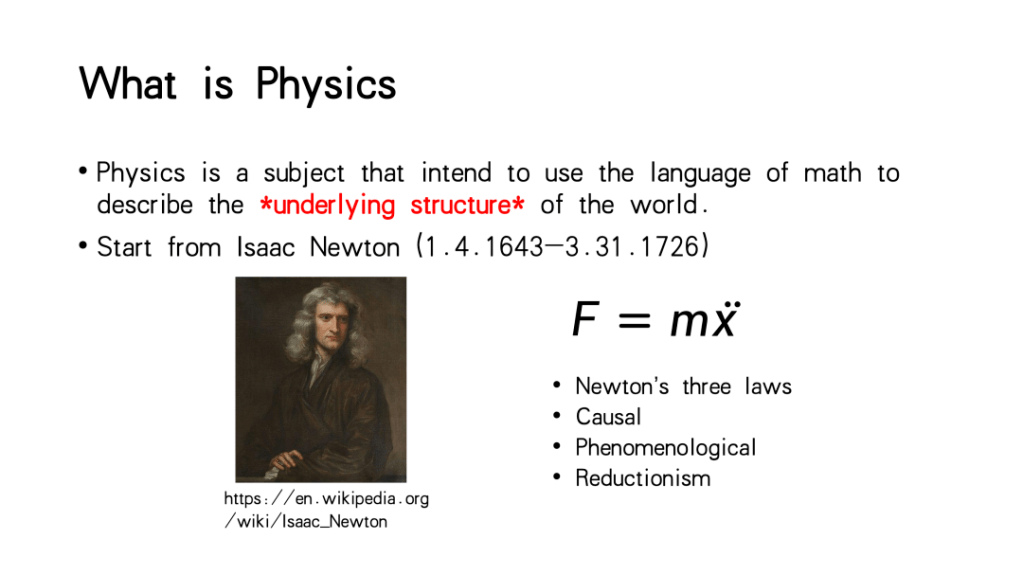
In modern physics, Sir Isaac Newton (1643-1726) stands out with his formulation of the three laws of motion, laying the foundation for the physical world for the next three centuries. His appeal to causality, phenomenology, and reductionism became important ideas in classical physics.
Joseph-Louis Lagrange (1736-1813) introduced the concept of extremization, understanding the maximum or minimum values of certain physical variables under physical constraints to establish idealized models.

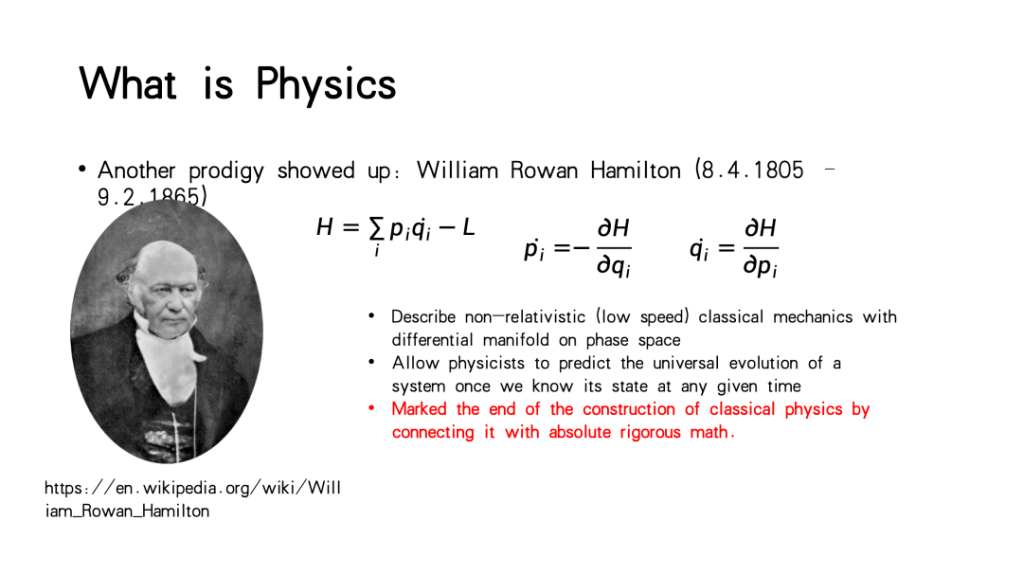
William Rowan Hamilton (1805-1865) marked the end of the construction of classical physics in the next century, where everything could be calculated using given initial conditions and rigorous mathematics.
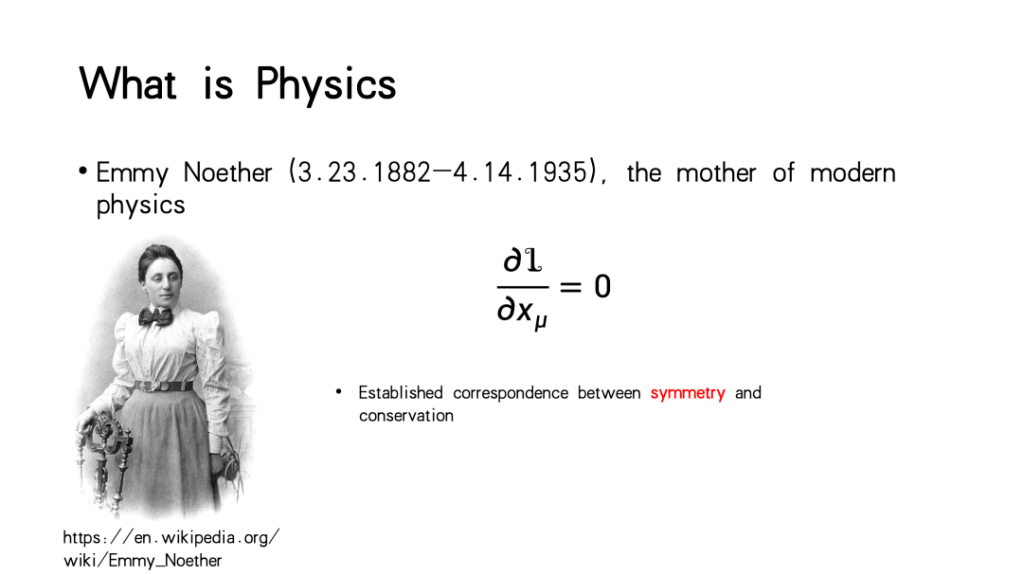
Entering the twentieth century, Emmy Noether (1882-1935) faced societal obstacles but still discovered one of the greatest theorems in physics. Her Noether’s theorem connected two very important concepts: conservation laws and symmetry.
In the rapid twentieth century, we gained quantum mechanics from the works of Max Planck and the spacetime concepts from Albert Einstein.
2 What can physicist derive from biological systems?
This series of concepts allows us to explain common systems. From crystals to remote entanglement, it seems that they can be described at least in part. Therefore, as a system existing in the world, biology can also be understood through physics.
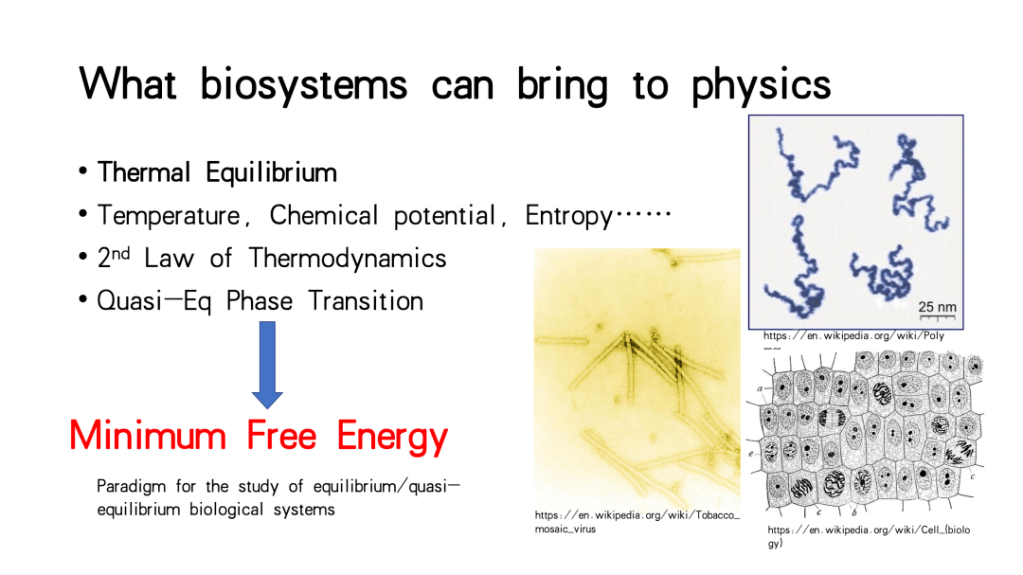
Contemporary physics has a comprehensive set of theories to describe thermal equilibrium systems. The Second Law of Thermodynamics/Minimum Free Energy Principle allows us to describe (quasi) equilibrium biological systems.
However, biological systems go beyond quasi-equilibrium states. Non-equilibrium phenomena, such as viral infections and protein folding, are inspiring for the study of physics.
Additionally, life systems are physical systems that can spontaneously depart from equilibrium. For example, many bird species tend to flock together, but only a relatively small number actually fly together. In the 1970s, biologist Frank Heppner from the University of Rhode Island introduced the concept of “flight formations”:
When a large number (thousands) of birds/fish (or any self-propelled particles) gather to form a large group, emergent regularities appear at the macro level, whereas this regularity does not exist when the group consists of a small number of birds/fish (swarm behavior).【2】
What interests physicists is how this macroscopic regularity emerges from the behavior of individual birds. In more abstract terms, this poses a fascinating problem of phase transition in active systems. Physicists aim to understand why macroscopic systems composed of numerous small active entities undergo a transition from chaos to order as the number of active entities increases.
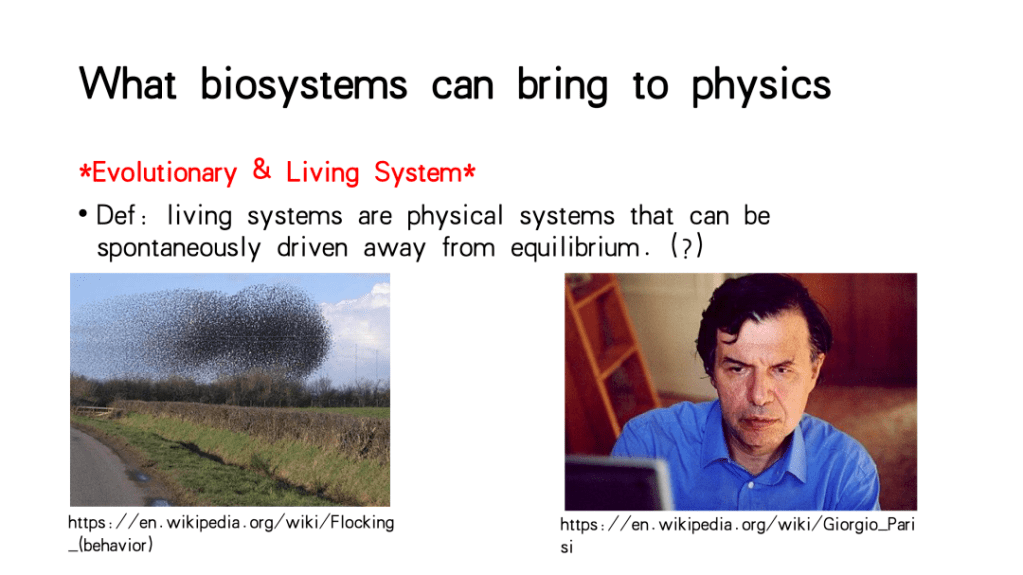
In addition to actively departing from equilibrium, as seen in bird flocks, there are many biological systems that deviate from equilibrium without consciousness but rather as a result of increasing free energy. Examples include dynamic immune systems, stem cells, cancer, hearing, neurons, and bacteria. Evolutionary systems, such as drug resistance, ecology, and viruses, also exhibit this behavior.
Such dynamics and evolution enable local systems to achieve lower entropy values and attempt to maintain these lower levels without violating the overall entropy increase in the entire universe.
参考文献
【1】Wang, Hanjie. Seminar Slides. Feb 2023.
【2】https://en.wikipedia.org/wiki/Isaac_Newton
【3】https://en.wikipedia.org/wiki/Joseph-Louis_Lagrange
【4】https://en.wikipedia.org/wiki/Will%20iam_Rowan_Hamilton
【5】https://en.wikipedia.org/%20wiki/Emmy_Noether
【6】https://en.wikipedia.org/wiki/Swarm_behaviour
【7】https://en.wikipedia.org/wiki/Tobacco_%20mosaic_virus
【8】https://en.wikipedia.org/wiki/Cell_(biolo%20gy)
【9】https://en.wikipedia.org/wiki/Flocking%20_(behavior)
【10】https://en.wikipedia.org/wiki/Giorgio_Pari%20si
In the next session, Rainy Liu will present a brief overview of Multiomics!
 In Transcription. @UCLA
Leave a comment