
Research Seminar
Students in the Research Committee of the fall 2022 semester organized and shared their research fields and results.
Through this, we can understand each other’s research focus and methods in different fields of biomedicine, increase academic exchanges, and exercise our scientific research reporting capabilities. Each issue will also briefly include relevant commercial R&D companies for reference.
*This article does not constitute medical advice. Please consult a regular doctor if you have any health questions.

– Speaker: Yiran Deng –
InT@UCLA Research Committee,
Undergraduate Researcher @Thompson & Reider Lab
at UCLA Health Orthopaedic Hospital Research Center
1. Why do we care about cerebral palsy?
Cerebral Palsy is one of the major diseases causing motor disability in children. The main principle is that during the brain development period of 0-5 years old, permanent brain damage (cerebral, brain lesion) leads to progressive movement problems (palsy).
Patients with cerebral palsy often face symptoms such as loss of control of movement ability, inability to balance the body, and progressive skeletal muscle atrophy.

2. How is the research progress on cerebral palsy’s effects on muscle?
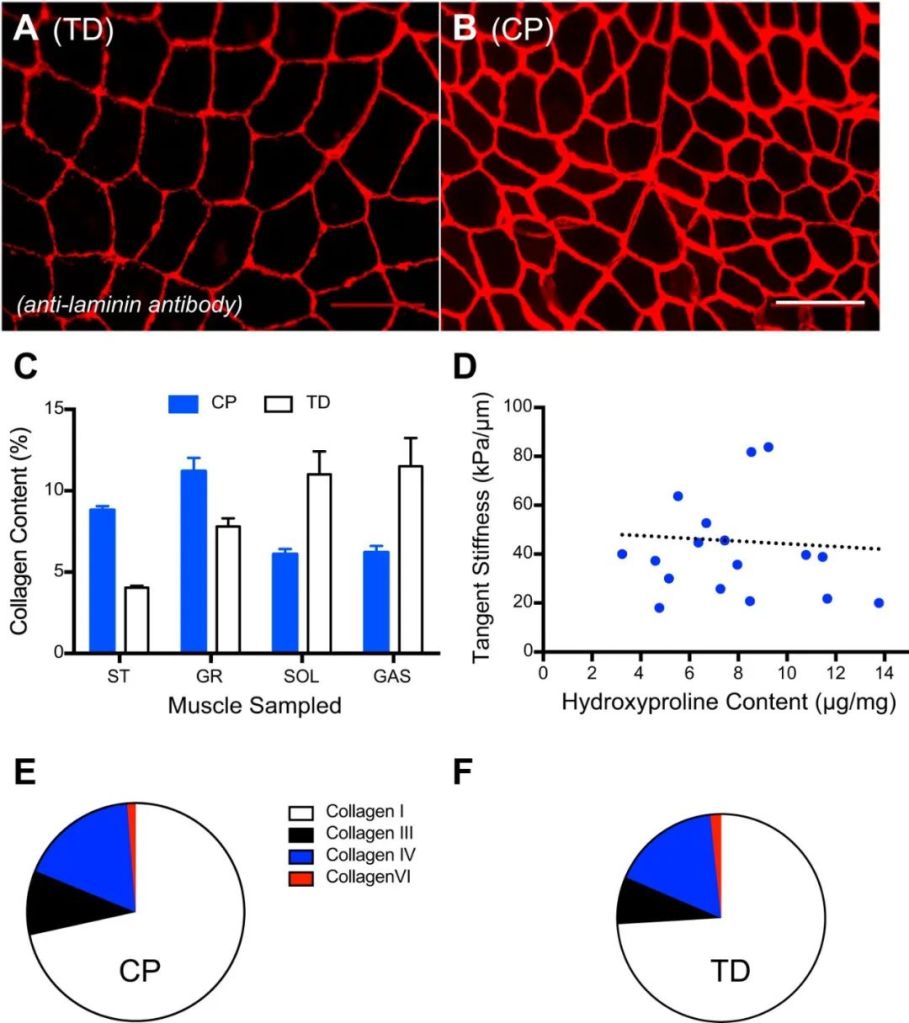
In earlier studies, scientists learned that because the muscle growth of children with cerebral palsy during development cannot keep up with bone growth, it will lead to muscle stiffness and fibrosis. In addition to mechanical characteristics of exercise capacity, biochemical characteristics of the extracellular matrix (ECM) are also a focus of research into muscle pathology.
Laminin and collagen in ECM are often studied. From the picture below, we can see that in the ECM of the muscles of children with cerebral palsy, laminin is thicker, and some collagen is also increased.
3. Our Research
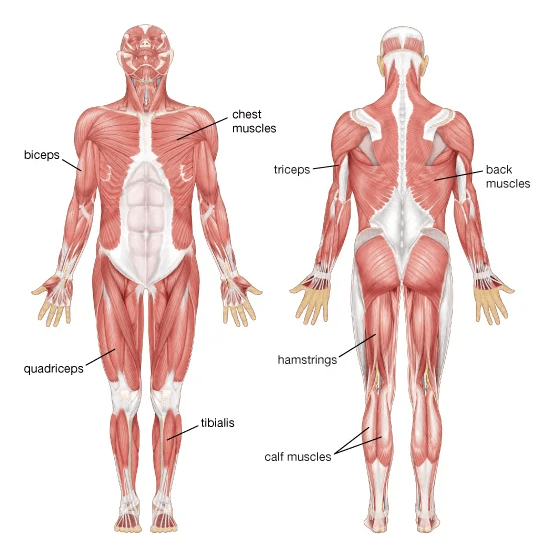
Previously, the main research was on the hamstrings on the back of the thigh and the Plantar flexor on the back of the calf, but our laboratory is more interested in the quadriceps on the front of the thigh.
At the same time, previous studies mainly used the chemical hydroxyproline assay (HYP) to measure the percentage of each component of ECM in the whole muscle section indirectly. HYP is one of the main components of collagen.
Our laboratory uses the immunofluorescence assay (IFA) method to measure the content of each component directly using antibodies specific to each component, hoping to achieve more accurate results and deepen our understanding of the similarities and differences in their functions.
However, we also have many future directions to explore, such as quantification of muscle tissue assessment, age and gender differences within samples, etc.

4. Outlook and the industry?
Currently, rehabilitation treatment for cerebral palsy includes nerve growth factor drugs, anti-spasticity drugs such as botulinum toxin type A (BoNT-A), surgery, and methods combined with physical therapy and training. 【2】
Some drugs still have orphan drug exclusivity, such as Ipsen’s DySport and Abbvie’s Botox, which are used to relieve upper/lower limb spasticity caused by cerebral palsy. 【3】【4】
Citations
【1】Lieber, Richard L., and Jan Fridén. “Muscle contracture and passive mechanics in cerebral palsy.” Journal of applied physiology 126.5 (2019): 1492-1501.
【2】中国康复医学会儿童康复专业委员会, 中国残疾人康复协会小儿脑性瘫痪康复专业委员会, 中国医师协会康复医师分会儿童康复专业委员会, 等. 中国脑性瘫痪康复指南(2022)第四章:康复治疗(下) [J] . 中华实用儿科临床杂志, 2022, 37(17) : 1281-1309. DOI: 10.3760/cma.j.cn101070-20220718-00875.
【3】INSERM US14 — ALL RIGHTS RESERVED. (n.d.). Orphanet: Dysport. Orphanet: DYSPORT. Retrieved January 24, 2023, from https://www.orpha.net/consor/cgi-bin/OC_Exp.php?lng=EN&Expert=33351
【4】Ipsen announces updated indication for Dysport® (abobotulinumtoxina) for the treatment of spasticity in children. Ipsen US. (2020, July 10). Retrieved January 24, 2023, from https://www.ipsen.com/us/blog/press-releases/ipsen-announces-updated-indication-for-dysport-abobotulinumtoxina-for-the-treatment-of-spasticity-in-children/
【5】Eldridge, Alison. “hamstring”. Encyclopedia Britannica, 14 Oct. 2022, https://www.britannica.com/topic/hamstring. Accessed 25 January 2023.
【6】https://www.novusbio.com/products/hydroxyproline-kit_nbp2-59747
【7】Chaturvedi, Vishal, et al. “Interactions between skeletal muscle myoblasts and their extracellular matrix revealed by a serum free culture system.” PloS one 10.6 (2015): e0127675.
【8】Csapo, Robert, Matthias Gumpenberger, and Barbara Wessner. “Skeletal muscle extracellular matrix–what do we know about its composition, regulation, and physiological roles? A narrative review.” Frontiers in Physiology 11 (2020): 253.
In the winter semester, the Research Committee will focus more on summarizing various fields. Stay tuned!
 In Transcription. @UCLA
Leave a comment